
Gearies Primary School
Attendance and Absence
Gearies Primary school
Being in School Matters
Why attendance at school is so important:
Excellent attendance at school is important to allow a child to fulfil their potential.
Government reports show that there is a clear link between poor attendance at school and lower academic achievement. In fact, of pupils with absence over 50%, only 3% manage to achieve five or more GCSEs at grades A*-C including maths and English.
Why attendance is important
Socialisation
When children and young people spend time in social settings away from their primary caregivers, they build their social network and skills. This allows their sense of self and identity to grow and to be tested out in lots of different scenarios. School provides us with one of those opportunities for safe exploration. In school, pupils get a sense of who they are, and how that identity sits alongside everyone else. It helps them to develop a sense of sympathy and empathy, and to become both independent and interdependent.
Resilience
Attending school helps pupils to become resilient. Everyone experiences days where they feel like they don’t want to do something, but having to overcome those initial feelings builds the resilience to continue trying. A school environment also builds resilience because answers aren’t always quickly available like they may be at home. Schools help our children and young people to learn to stick at something for a little bit longer. Resilience is also developed through the ups and downs of relationships with peers.
Physical and emotional safety
Unfortunately, not every young person has an idyllic home life. School provides the ability for adults to check in on their safety. It’s also a place where the pupils can feel safe and connected, where they can share their problems with their peers and feel emotionally supported.
Having needs met
At school, the basic needs of a child or young person are met. They are warm, dry, fed and have someone there to look after them.
Attainment
Good attendance has a strong correlation with attainment. Young people that achieve good grades and pick up the skills to concentrate and engage with their learning are more likely to be able to support themselves as adults and contribute to society.
Miss school - miss out!
Young people who regularly miss school are more likely to become isolated from their friends, underachieve and become involved in anti-social behaviour.
How parents can help
- Establish a good routine in the mornings and evenings so that your child is prepared for the school day ahead
- Ensure your child arrives at school on time. Being late is very unsettling for your child and means they miss a crucial part of the school day
- Arrange dental and medical appointments outside school hours when possible
- Always inform the school if your child is absent due to illness and follow it up with a written note when your child returns to school, including medical evidence
- Take family holidays outside of term time
- Talk to your child about school and engage with homework and topics covered
- Attend parents’ evenings and school events - this shows your child how much you value their education
- Praise and reward your child for their achievements in school
- Discuss any problems or difficulties with the school - staff are there to help and will be supportive
- Recognise that we are working in partnership for the good of your child (see home school agreement)
Do not be afraid to ask for help if a problem arises.
Family Holidays
You can demonstrate your commitment to your child’s education by not taking holidays during term time. Any child who is absent from school will miss out on important learning and will fall behind in their school work.
In each academic year there are only 190 statutory school days - this allows for plenty of time for holidays to be arranged outside of term time across the remaining 175 days.
Holidays taken during term time will be categorised as an unauthorised absence and may result in a fine.
Every single day a child is absent from school equates to a day of lost learning.
Attendance percentages can be misleading. Our school target is 96.5%.
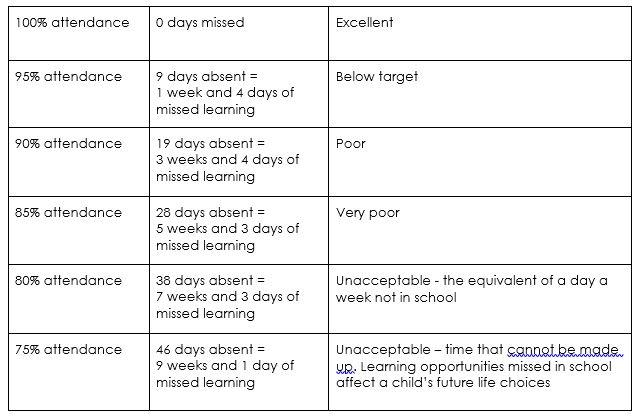
For some parents, 90% may seem like an acceptable level of attendance, but in reality, it means that your child will miss half a day at school each week, or 19 days of school during the year… that’s nearly 4 weeks off school.
Missing just 5 days of every term of every year from Reception to year 13 equates to missing more than one whole school year!
Give your child the best start in life - every school day counts.
What the law says
Local councils and schools can use various legal powers if your child is missing school without a good reason. They can give you:
- a Parenting Order
- an Education Supervision Order
- a School Attendance Order
- a fine (sometimes known as a ‘penalty notice’)
You can be given one or more of these but the council does not have to do this before prosecuting you.
Parenting Order: This means you have to go to parenting classes. You will also have to do what the court says to improve your child’s school attendance.
Education Supervision Order: If the council thinks you need support getting your child to go to school but you are not co-operating, they can apply to a court for an Education Supervision Order. A supervisor will be appointed to help you get your child into education. The local council can do this instead of prosecuting you, or as well.
School Attendance Order: You will be given a School Attendance Order if the local council thinks your child is not getting an education. You have 15 days to provide evidence that you have registered your child with the school listed in the order or that you are giving them home education. If you don’t, you could be prosecuted or given a fine.
Fine: Your local council can give you a fine of £80 per parent per child, which rises to £160 if you don’t pay within 21 days. If you don’t pay the fine after 28 days you may be prosecuted for your child’s absence from school.
Prosecution: You could get a fine of up to £2,500, a community order or a jail sentence up to 3 months. The court also gives you a Parenting Order.
Education is not an option - it is compulsory.